What the Gulf crisis is really doing to brands, and what it means for the way we design them.
In this month’s The Brief, we explore how the Gulf crisis is turning supply chain disruption into a design problem. From Calbee’s monochrome crisp packets to K-beauty brands without jars and Malaysian milk without bottles, these stories reveal how deeply brand identity depends on the materials that carry it.
Calbee Goes Monochrome.
By Necessity, Not by Choice.
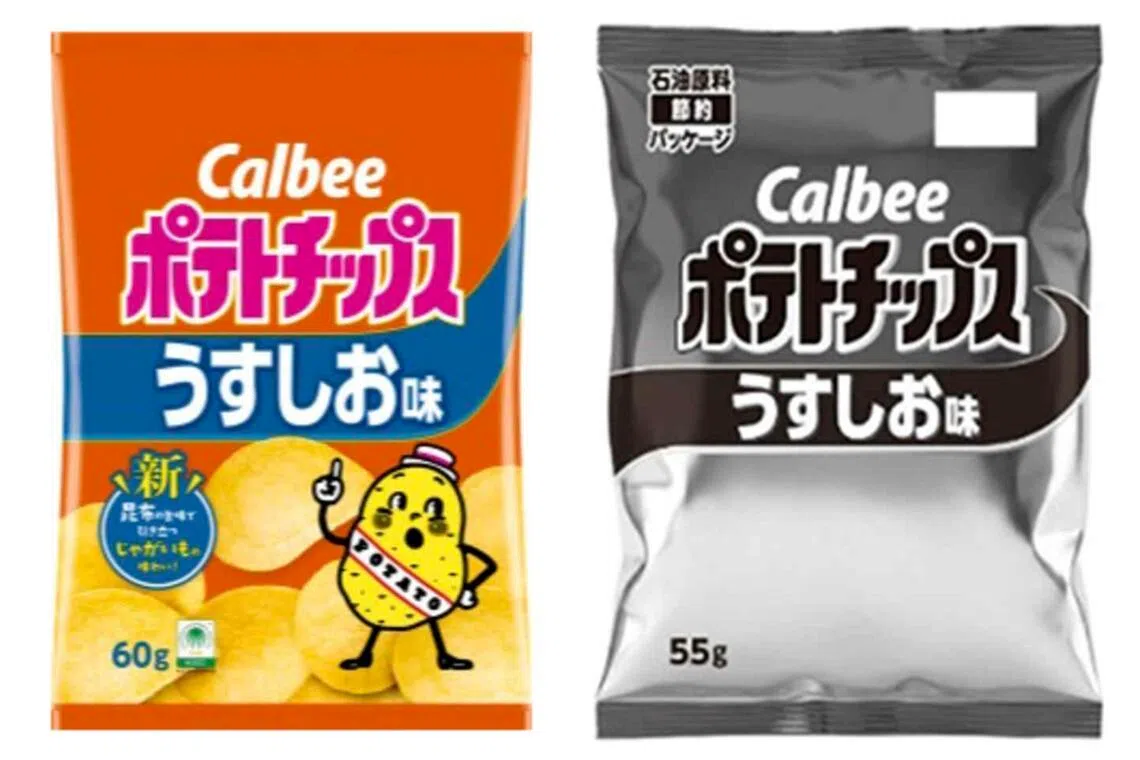
Japan's biggest snack brand, 77 years old and commanding half the country's crisps market, announced this week that 14 flagship products will ship in black and white from May 25. No red for lightly salted. No yellow-green for seaweed. Just greyscale, across a portfolio where colour has been the navigation system for decades.
The culprit is naphtha, a petroleum derivative used as both a plastic feedstock and a printing ink solvent. Japan imports over 60% of its naphtha, and 70% of that came through the Strait of Hormuz. Since February, that supply has effectively stopped. Printing ink manufacturers are now competing against plastic, pharmaceutical and fertiliser companies for the same shrinking pool of raw material.
Shiseido is exploring plant-based alternatives to oil-derived materials affecting products from moisturisers to lipstick. What started as a geopolitical crisis is arriving on the shelf as a design crisis.
"Colourful packaging will become difficult."
PRESIDENT, ITOHAM YONEKYU, WHICH ANNOUNCED IT MAY FOLLOW CALBEE'S LEAD

K-beauty Can't Find A Jar To Put Itself In.
Yonwoo manufactures the pots, pumps and tubes that K-beauty brands, including L'Oreal and Amorepacific, live in. In March, it told Reuters it was scrambling to secure plastic resin with "little visibility on the material beyond June." A company official was blunt: "The issue isn't the price. If supply itself isn't available, then without containers, you simply can't sell the product."
Meanwhile South Korean supermarkets reported shortages of garbage bags. Shoppers bought them in bulk. Stores limited purchases. A geopolitical crisis had found its way to the most mundane object in a household and made it feel precarious.
No Carton. No Milk.
Farm Fresh Runs Dry on Shelves.
Malaysian dairy brand Farm Fresh, one of Southeast Asia's most recognisable fresh milk labels, told the Straits Times that a shortage of PET resin was the direct reason consumers could not find its cartons on supermarket shelves. Not a production problem. Not a distribution problem. A packaging problem. The milk existed. The bottle did not.
It is a quietly devastating illustration of the impact of the blockade. Like many brands Farm Fresh's identity, built around being clean, fresh and local, lives inside a specific container format. When that format disappears from shelves, so does the brand, regardless of what sits in the factory, most of which is perishable.
The same story is playing out in Japanese convenience stores, where mid-sized manufacturers of cup puddings, a staple of the conbini aisle, are considering suspending sales because they cannot secure sufficient plastic containers in time. One company told Nikkei: "If procurement is blocked, we have no choice but to halt shipments." Not a flavour problem, nor a price problem, a cup problem.
"When packaging becomes scarce or expensive, food spoilage increases, logistics costs rise and passed on to consumers."
LI DONG, SUPPLY CHAIN EXPERT, NANYANG TECHNOLOGICAL UNIVERSITY, SINGAPORE
What Does This Mean for Brand Design?
These stories share a single uncomfortable insight: the materials that carry a brand's identity are not neutral. Colour, packaging, texture, the vocabulary designers work in daily, all flow from petrochemical feedstocks that most brand teams have never thought about.
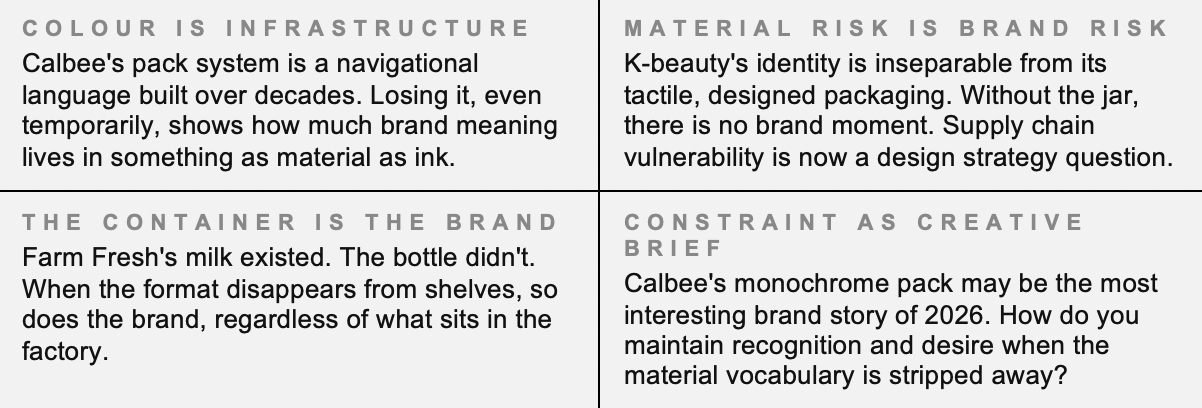
The Gulf crisis is, among other things, a reminder that brand design does not exist above the material world. It depends on it, and right now, that world is pressure in ways that will test the resilience of every brand we build.
Sources: Nikkei Asia, Fortune, Reuters, Straits Times, FoodNavigator, Seoul Economic Daily, May 2026