
We've been sitting with a tension worth debating this month. AI can now replicate much of the visible output of creative work with remarkable accuracy. What it still struggles to replicate is the reason people care about that work in the first place.
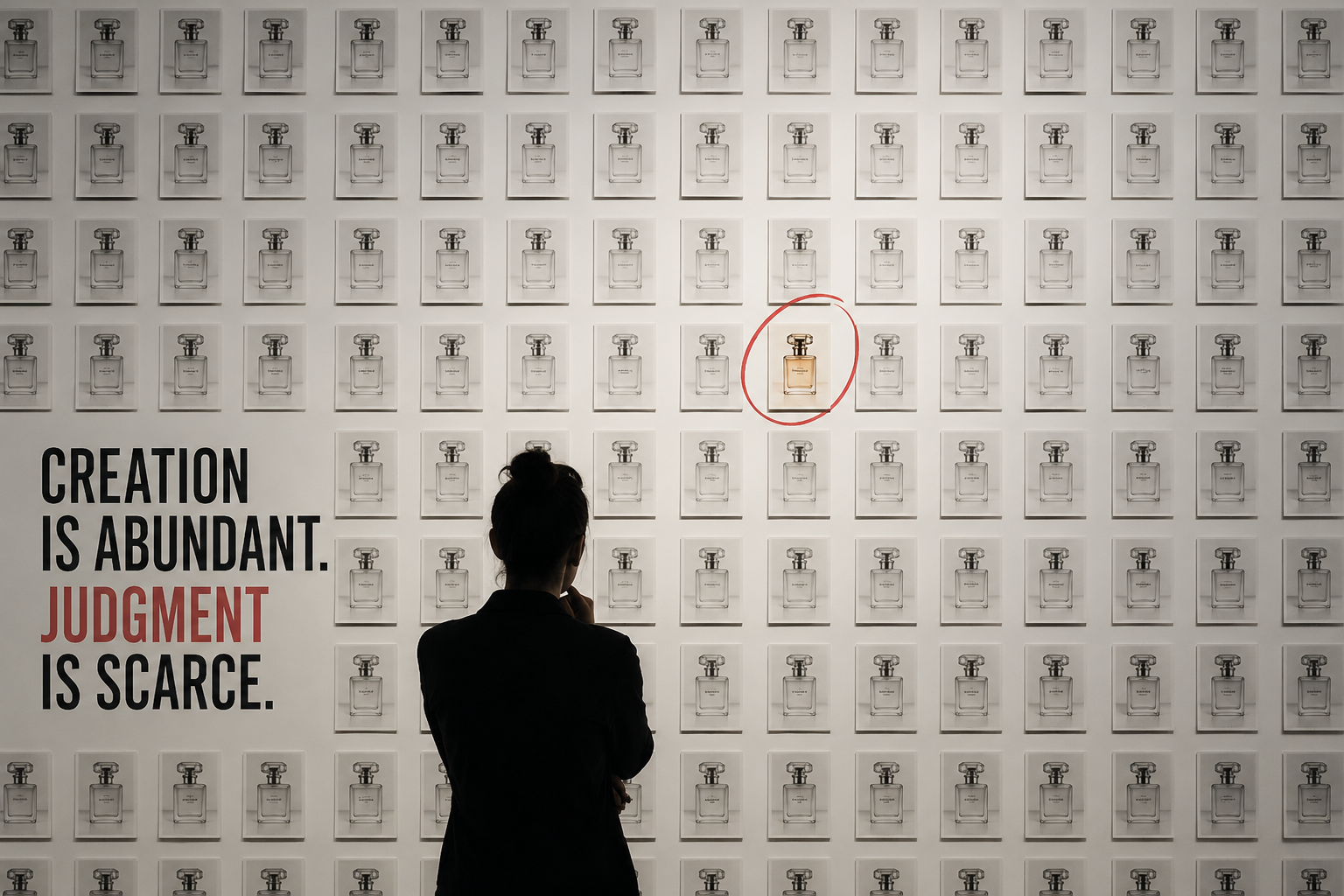
As execution becomes easier to generate, value moves elsewhere. Not into the work itself, but into the judgment behind it. Into authorship. Into the decisions about what is worth making, why it matters, and who it is for. That shift matters enormously for brands.
Right now, in Singapore's Gardens by the Bay, someone is standing inside an inflatable version of a hand-drawn toy and taking a photograph of themselves to post onInstagram. They paid for the privilege. They probably queued for it. And the artist whose work made all of this possible has never once worried about AI.
CJ Hendry is, on paper, the artist most exposed to what AI does best. Her practice is built on hyperrealism: painstakingly detailed drawings rendered so precisely they resemble photographs. It is exactly the kind of output AI can imitate.AI-generated versions of her work already circulate online. Someone even slipped one into a real exhibition to see if anyone would notice.
Yet JuJu World continues to draw crowds. Her collectibles have waitlists. Her exhibitions sell out.
The reason is not mysterious. People were never paying for technical execution alone. What draws audiences to Hendry's work is everything surrounding the image: the hundreds of hours invested in each piece, her particular choices of subject matter, the anticipation she builds around each release, the relationship she has cultivated with her audience by sharing her process over time. A machine may be able to recreate the aesthetic. It cannot recreate the authorship.
This is not a story about craft as nostalgia. It is a story about where value actually lives, and what happens to it when execution becomes cheap.
The Question Most Brand Teams Are Asking Is the Wrong One
The anxiety most marketing and brand teams feel about AI is framed around a question that misses the point: can AI do what our agency does?
The more useful question is: what did we actually hire our agency to do?
If the answer is produce assets faster, generate options, fill content calendars, or execute production at scale, then AI will undoubtedly compress the value of that work. Those are execution problems, and AI is very good at execution.
But if the answer is helping a business understand what it should stand for, how it should behave differently across markets, where it should focus its attention, and what it should never do, then the conversation is about something else entirely. That work is built on judgment. The output can be generated. The judgment cannot.
Hendry understood this before AI was anyone's problem. She never sold hyperrealism as a product. She sold a point of view. The drawings were simply the vehicle.
The studios most threatened by AI are those whose entire value proposition was speed and volume. The ones that are not threatened are those whose value lives in the conversation before the brief, the argument in the room, the thing they talked a client out of doing.

Authorship Is Not a Creative Concern. It Is a Strategic One.
Most brand challenges we encounter are not, at their core, about aesthetics. They are about authorship, or the absence of it.
A brand optimised for consistency, but never built around a genuine point of view, is work that is technically correct and strategically empty. It can be maintained. It cannot be defended.
Hendry solved this problem by being irreducibly herself. Her audience did not just buy her drawings. They bought her judgment about what was worth creating. That relationship between maker and audience, built on trust and accumulated overtime, is not something that can be replicated. It is earned, decision by decision, conversation by conversation.
The same logic applies to brand. The brands holding their ground right now are not doing so because their visual identity is AI-proof. Their strength comes from conviction, not execution. From clarity about what they stand for, not from the sophistication of the tools they use.
AI makes production easier. It makes the absence of a point of view more conspicuous.The question is not whether your assets can be generated. It is whether the thinking behind them is clear enough to matter.